

You can have solid income, a healthy deposit, and still hit a wall with your home loan because of your credit history. A card that’s consistently near its limit, a few late payments, or an old default can make banks nervous, even if your current finances look fine.
Credit repair is the process of cleaning up that history and building better patterns so lenders feel comfortable saying yes. For Kiwi first-home buyers, that means understanding what shapes your credit score, what shows on your credit file, and the specific steps that help your score rise over time.
This guide focuses on how credit repair works in New Zealand, how it affects your mortgage options, and what you can do starting this week to lift your credit score and move closer to home ownership.
Mortgage Managers Tip: Start working on your credit at least 6–12 months before you plan to apply for a home loan, so you have time to show a solid pattern of on-time payments and lower debts.
Table of Contents
- Key Takeaways
- What Credit Repair Means For Kiwi Home Buyers
- What Really Influences Your Credit Score In New Zealand
- Step-By-Step Credit Repair Plan You Can Start Today
- How Long Credit Repair Takes Before You Apply For A Mortgage
- Banks Vs Non-Bank Lenders: How Credit Repair Affects Your Options
- Building Or Rebuilding Credit History From A Thin Or Damaged File
- Spotting Credit Repair Scams And Knowing When To Ask For Help
- How Mortgage Managers Can Support Your Credit Repair And Home Loan Goals
- Conclusion
- FAQs
Key Takeaways
Credit repair is about behavior, not quick tricks. Lenders care most about your recent payment history and current debt levels, not just a single score number.
Payment history and credit utilization carry the most weight. Paying on time every month and keeping card balances under 30% of their limits are the two biggest win factors.
Real results take months, not days. You might see improvements from lower balances in 1–2 months, but serious issues like defaults, collections, or bankruptcy need longer periods of consistent good behavior.
Banks and non-bank lenders treat past credit issues differently. Banks usually want a clean file and higher scores, while non-bank lenders can be more flexible but often charge higher interest rates.
You don’t need a paid “credit repair company.” With the right information, you can follow a clear step-by-step process yourself and get extra help from mortgage advisers when you’re ready to apply for a loan.
What Credit Repair Means For Kiwi Home Buyers

Credit repair is simply the process of:
Understanding what’s on your credit report
Fixing any errors
Improving the behaviors that lenders care about most
Your credit file is your financial track record. It shows:
Which credit accounts you have or had (cards, personal loans, car finance, buy-now-pay-later, etc.)
Whether you paid on time or late
Any defaults, serious credit infringements, or bankruptcies
How often you apply for new credit
In New Zealand, this information is held by bureaus like Equifax, Centrix, and illion. Lenders use it alongside income, expenses, and deposit size when they make mortgage decisions. For a detailed breakdown of what appears in your file, see this guide to your credit file for NZ buyers.
The good news is that lenders also have to follow New Zealand’s lending regulations under the CCCFA and the Responsible Lending Code. Those rules require a full look at your situation: income stability, essential expenses, existing debts, and whether the loan will be manageable for you — not just a single score.
So while your credit file matters a lot, it’s not the only factor. Credit repair is about turning that file into a story that fits what responsible lenders want to see.
What Really Influences Your Credit Score In New Zealand
Credit scoring models vary, but they usually rely on similar ingredients. If you understand these, you’ll know exactly where to focus your credit repair efforts.
1. Payment History
This is the single biggest factor in your credit score.
Lenders look at:
Have you paid all debts and bills on time?
Are there late payments, defaults, or collections?
How recent are those issues?
Even one payment reported as 30 days late can drag your score down. Patterns matter even more: several late payments in a row or multiple overdue accounts will worry lenders.
What helps:
Paying every bill (credit cards, personal loans, utilities, phone, internet) on or before the due date
Keeping accounts current if you’re in hardship by arranging temporary payment plans with your providers
Building a consistent 6–12 month stretch of on-time payments before you apply for a home loan
Mortgage Managers Tip: If you can only change one habit this year, make it paying every bill on time. Your payment history is the foundation of a stronger credit score.
2. Credit Utilisation (How Much Of Your Limit You Use)
Credit utilisation is the percentage of your available revolving credit (mainly credit cards and overdrafts) you are currently using.
Example:
Total card limits: $10,000
Balances owing: $6,000
Utilisation: 60%
High utilization suggests financial stress, even if you never miss a payment. Most scoring systems reward you for staying under 30% on each card and across all cards combined — learn how to Master your debt-to-income ratio to keep your overall borrowing position strong.
What helps:
Reducing balances so each card sits under 30% of its limit
Avoiding maxed-out cards and frequent cash advances
Not swinging balances up and down every month if you can avoid it
3. Length Of Credit History
The longer you’ve successfully handled credit, the more information lenders have to judge you.
They look at:
When your oldest account was opened
How long you’ve held your current accounts
Whether there’s a long gap with no active credit at all
What helps:
Keeping your oldest card or account open (especially if it has no annual fee)
Avoiding closing accounts purely to “tidy up” while you’re rebuilding credit
4. New Credit And Inquiries
Every time you apply for credit (cards, loans, BNPL, store finance), the lender usually performs a hard inquiry on your file. Too many in a short span suggests you might be over-committing.
What helps:
Only applying for new credit when you truly need it
Spacing out applications and avoiding multiple card or BNPL signups in one burst
5. Serious Negative Events
Some events are much heavier strikes against your file:
Defaults (where a lender reports a serious missed payment)
Collections
Serious credit infringements
Bankruptcy or No Asset Procedure
These stay on your New Zealand credit file for years, often five to seven years, even after the debt is paid. They don’t guarantee a decline forever, but they limit your options and may push you toward non-bank lending routes for a while. If that’s you, this guide on how to qualify for a mortgage with defaults is a helpful next step.
Step-By-Step Credit Repair Plan You Can Start Today
You don’t need to hire a credit repair company to clean up your file. Every legal step they can take, you can also take yourself for free.
The process works best if you follow a simple sequence and stick to it.
Step 1: Get Your Credit Reports
Request your reports from:
Equifax
Centrix
illion
Check all three because they may hold slightly different information, and lenders can look at any of them.
Use resources like this guide to your credit file for NZ buyers and these improving credit score tips for extra detail on what you’re reading.
Step 2: Check For Errors And Dispute Them
Go through each report carefully and look for:
Accounts you don’t recognize
Payments marked late that you know were on time
Duplicated debts
Old negatives that should have dropped off already
Wrong personal details (address, date of birth, employer)
If something looks wrong:
Contact the credit bureau in writing or via their online dispute form.
Provide any supporting evidence (bank statements, emails, receipts).
Contact the lender or company that reported the information.
Keep copies of all correspondence and reference numbers.
Under New Zealand’s Credit Reporting Privacy Code and consumer rules described in the NZ lending regulations, the bureau must investigate and correct information that can’t be verified.
This alone can lead to meaningful credit repair if major errors are removed.
Step 3: Bring Overdue Accounts Up To Date
Next, focus on any accounts that are currently:
Past due
In arrears
With a collection agency
Contact each lender and:
Ask for the full amount needed to bring the account current
Discuss hardship options if you genuinely can’t afford that amount
Commit to a realistic payment plan you can stick to
Once an account is back in good standing, the negative history doesn’t vanish overnight, but you stop adding new damage. From here on, your job is to stack up positive months.
Step 4: Set Up Automatic Payments And Reminders

Payment history drives credit repair over time. Protect yourself from accidental misses by:
Setting up direct debits or automatic payments for at least the minimum payment on every credit account
Adding calendar reminders a few days before each due date
Keeping a buffer in the account you use for those payments
Tools and routines that support on-time payments are covered in this credit monitoring guidance, which can help you keep track of your progress.
Mortgage Managers Tip: Automate as much as you can, then use reminders as a safety net. A simple system beats relying on memory when life gets busy.
Step 5: Lower Your Credit Utilisation
This is where many Kiwi buyers see the fastest visible gains in their credit score.
Work out your utilisation:
Add up all your credit card and overdraft balances
Add up your total credit limits
Divide balances by limits and multiply by 100
Aim to get below 30% on each card and across all cards combined.
If you can’t pay balances down quickly, consider:
Redirecting extra cash to the highest-interest card
Moving spending to your EFTPOS/debit card until balances fall
Many buyers see noticeable score improvements within a month or two once they follow structured fix credit before buying home strategies centered on utilization and timely payments.
Step 6: Build A Simple Debt Repayment Strategy
If you’re juggling several debts, a clear plan helps you make real headway:
Debt avalanche: Pay extra on the debt with the highest interest rate first while making minimums on all others.
Debt snowball: Pay extra on the smallest balance first for quick psychological wins, then roll that payment onto the next smallest.
You might also consider a consolidation loan, but only if the rate and fees genuinely leave you better off. This can simplify repayment and reduce interest, but be careful not to run balances back up afterward.
The framework in this guide to rebuilding credit for NZ home loan eligibility walks through how debt reduction, on-time payments, and careful credit use work together.
Step 7: Pause New Credit Applications
While you’re repairing your credit:
Avoid new credit cards, store cards, and finance deals where possible
Be cautious with buy-now-pay-later services, as they can lead to multiple inquiries and small debts that add up
Only apply for credit you genuinely need and can afford
Fewer hard inquiries and fewer new accounts make your overall file look steadier to lenders.
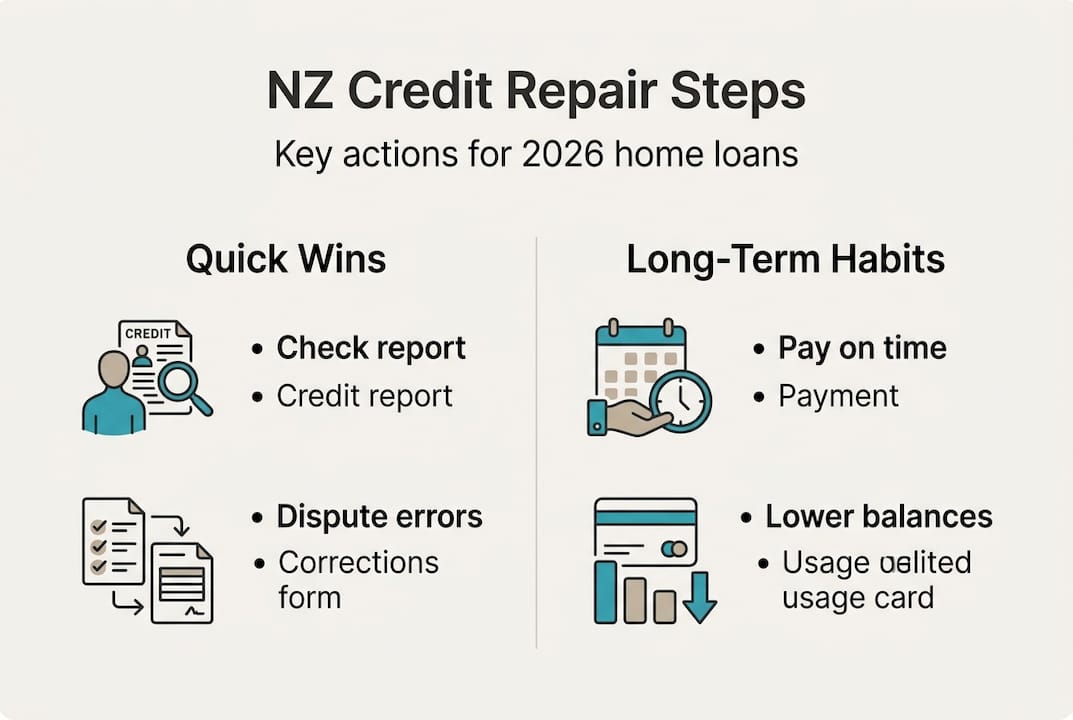
Using these steps alongside targeted improving credit score tips and ongoing credit monitoring guidance gives you a clear path forward.
How Long Credit Repair Takes Before You Apply For A Mortgage
Every credit file is different, but there are some common timeframes that help set expectations and planning.
Typical Credit Repair Timelines In New Zealand
| Credit Issue | Time To See Improvement | Time It Stays On Your File |
|---|---|---|
| High utilization (maxed-out cards) | 1–2 months after paying down | Updated as soon as lender reports lower balances |
| A single late payment | 3–6 months of on-time payments | Up to 5 years |
| Multiple late payments | 6–12 months of good behavior | Up to 5 years |
| Defaults | 6–24+ months of good behavior | Usually 5 years |
| Serious credit infringements | 1–3 years of stable behavior | Often up to 7 years |
| Bankruptcy | Several years of rebuilding | Often up to 7 years |

A few key points:
Reducing high utilization can improve your score quite quickly.
Lenders care about trends — a file moving steadily in the right direction is far more appealing than one stuck in the same poor pattern.
You don’t always need to wait until every mark drops off; some non-bank lenders are open to borrowers partway through their recovery, especially if you’re following clear fix credit before buying home steps.
If you have defaults or other heavy marks, read this guide on how to qualify for a mortgage with defaults for a realistic look at timing and options.
Mortgage Managers Tip: Focus less on “What’s my score this week?” and more on “What pattern am I showing over the next 6–12 months?”
Banks Vs Non-Bank Lenders: How Credit Repair Affects Your Options

Once your credit repair efforts are underway, the next question is, “Who is likely to lend to me, and on what terms?”
How Banks View Credit
Big banks in New Zealand usually want to see:
Strong, recent payment history
Few or no late payments in the last 12–24 months
No serious unpaid defaults
A credit score typically above the mid-600s (exact cutoffs vary by lender)
They also look closely at your income, expenses, and debt-to-income ratio — understanding How Lenders Assess Risk in New Zealand gives you a clearer picture of what banks are looking for at each stage of the process.
If you meet those standards, you’re more likely to access lower interest rates and standard bank mortgage products.
How Non-Bank Lenders View Credit
Non-bank lenders (sometimes called specialist or near-prime lenders) are usually:
More willing to work with past credit issues
More focused on your current situation and the story behind the problems
Often open to borrowers early in their recovery phase
The trade-off is cost. As this guide to non-bank loan options explains, interest rates are usually higher to reflect the extra risk.
Many buyers use a non-bank loan as a stepping stone:
Use non-bank lending to buy their first home earlier than a bank would allow
Keep repairing their credit and lowering their debts
Refinance to a mainstream bank once their file and finances are stronger
Practical approval tips for bad credit can help you choose between these paths and time your applications wisely.
Mortgage Managers Tip: Think about your second loan as well as your first. A short period with a non-bank lender can work if you have a clear plan to move back to a bank once your credit improves.
Building Or Rebuilding Credit History From A Thin Or Damaged File
If you’re new to credit, returning from overseas, or coming back after a rough patch, you may need to actively build history as part of your credit repair plan.
Useful strategies include:
Use Existing Accounts Wisely
Keep old accounts open where they don’t cost you extra fees
Set small, manageable recurring expenses (like streaming services) on a card and pay it off in full each month
Avoid carrying balances close to your limits
Consider “Starter” Credit Products
New Zealand’s range of formal “credit-builder loans” and secured cards is more limited than in some countries, but the principles still apply:
Low-limit credit cards used gently and paid in full each month can help you build a positive track record.
Some lenders offer loans that double as savings vehicles, helping you create a deposit while reporting on-time payments to the bureaus.
Resources on rebuilding credit for NZ home loan eligibility and structured improving credit score tips walk through how to use these tools without overspending.
Keep Applications Low And Purposeful
When you’re rebuilding:
Avoid applying for lots of different products “to build credit”
Be selective and give each new account time to help your record before adding more
Regular checks using the credit monitoring guidance will show how your efforts are tracking and help you spot any new issues early.
Spotting Credit Repair Scams And Knowing When To Ask For Help
Most Kiwi buyers can handle credit repair on their own, but the internet is full of “quick fix” promises that can set you back.
Red Flags For Credit Repair Scams
Be very wary if a company:
Demands large upfront fees before doing anything
Promises to remove accurate negative information from your file
Tells you to dispute everything on your report, even if it’s true
Suggests using a new identity or alternative IRD-style number
Advises you not to contact credit bureaus or lenders yourself
Won’t clearly explain your rights or provide a written contract
Accurate, verifiable negative information cannot legally be wiped away. Time and better behavior are the only real cures.
Mortgage Managers Tip: If an offer sounds too good to be true — like “cleaning” your file in a few days — treat it as a warning sign rather than a shortcut.
When Professional Support Makes Sense
Extra help can be useful when:
You have several debts and feel stuck choosing what to pay first
You’re in hardship and need help dealing with creditors
You’re close to applying for a mortgage and want a professional view on your chances
Free or low-cost financial mentoring is available through New Zealand community services, and when you reach the point of planning a home loan, experienced mortgage advisers become especially valuable.
How Mortgage Managers Can Support Your Credit Repair And Home Loan Goals

Knowing the steps is one thing. Understanding how your specific situation fits with real lenders is another.
Mortgage Managers advisers work with both mainstream banks and specialist non-bank lenders. That means they can:
Review your income, expenses, and credit file
Explain how different lenders are likely to view your application
Suggest practical steps to strengthen your file over the next 3–12 months
Help you decide when to go straight to a bank and when to consider a non-bank option first
You want to make sure that you are working with the best, and so we suggest that you reach the team directly through the Mortgage Managers contact page.

When you’re ready to move from credit repair into active home loan planning, Mortgage Managers can guide you through the full mortgage application process, help you compare different lenders, and show you where you stand under current credit assessment rules.
Think of their personal mortgage advisers as “personal shoppers” for your home loan: they know the products on the shelf and which ones fit people with a history like yours. This guide to the role of advisers in home buying explains how that support works in more detail.
Conclusion

Credit repair for New Zealand first-home buyers comes down to a few clear ideas:
Know what’s on your credit file and correct any mistakes
Pay every bill on time, every time, from now on
Bring overdue accounts up to date and keep utilization low
Avoid unnecessary new credit while you’re rebuilding
Choose lenders and timing that fit the state of your file
You don’t need perfection to buy your first home, but you do need a story lenders can take confidence from. The sooner you start improving that story, the more choices you’ll have — and the less interest you’re likely to pay over the life of your mortgage.
FAQs
How Long Does Credit Repair Usually Take Before I Can Apply For A Home Loan In New Zealand?
Minor improvements, like lowering high card balances, can start showing in 1–2 months, because lenders update your utilization once they report new balances. Fixing late payments, defaults, or a long history of missed bills takes longer. Many buyers need 6–24 months of consistent on-time payments and lower debts before banks are comfortable, though some non-bank lenders may consider you sooner.
Is There A Minimum Credit Score For Banks Compared With Non-Bank Lenders?
There’s no single nationwide cutoff, but banks usually prefer scores in the mid-600s or higher, with a clean recent payment record. Non-bank lenders may accept lower scores or past issues if you now have stable income and a sensible plan, but they often charge higher interest rates. Guidance on approval tips for bad credit can help you weigh these options.
What Has The Biggest Impact On Improving My Credit Score?
Payment history and credit utilization carry the most weight. Paying every bill on time and reducing your card balances below 30% of their limits are the two strongest moves you can make. The combination of those habits, followed consistently over several months, is at the heart of rebuilding credit for NZ home loan eligibility.
What Laws Protect Me While I’m Repairing Credit Or Applying For A Mortgage?
New Zealand’s CCCFA and the Responsible Lending Code — covered in this responsible lending guide — require lenders to check that loans are affordable and suitable for you. The Credit Reporting Privacy Code also sets rules for how your information is collected, stored, and corrected. Those rules give you the right to dispute errors and expect fair treatment during the credit assessment process.
How Can Mortgage Managers Help With My Credit Repair And Home Loan Plans?
Mortgage Managers advisers can look at your current credit report, income, and deposit, then explain which lenders are realistic now and which might be possible after more credit repair progress. They guide you through the mortgage application process, recommend steps to strengthen your file, and act as your advocate with banks and non-bank lenders. You can learn more about the role of advisers in home buying or contact the team directly through their contact page.