Most of us think we want a lot more income, but what we really want is more of our earnings (money) left over after paying our expenses.
Aim for that instead, and the goal shrinks from tens of thousands a year to a few hundred dollars a month.
The problem with “just earn more”
“Increase your income” is some of the most common money advice out there, and some of the most ignored. People push back for three reasons: they don’t believe they can, they don’t think they should have to, and costs keep climbing anyway.
If you’re on $80,000 and someone tells you to go earn $120,000 or $160,000, the natural reply is “Yeah, good one mate.” So the idea gets shelved.
A listener recently passed on a better question: what if, instead of doubling your income, you tried to double your disposable income?
Step 1: Work out what’s actually left
Start with your take-home pay and subtract the necessities: rent or mortgage, groceries, power, internet and phone, insurance, transport and fuel, and debt repayments, which quietly eat your future income. What’s left is your disposable income, the money you actually get to make decisions with.
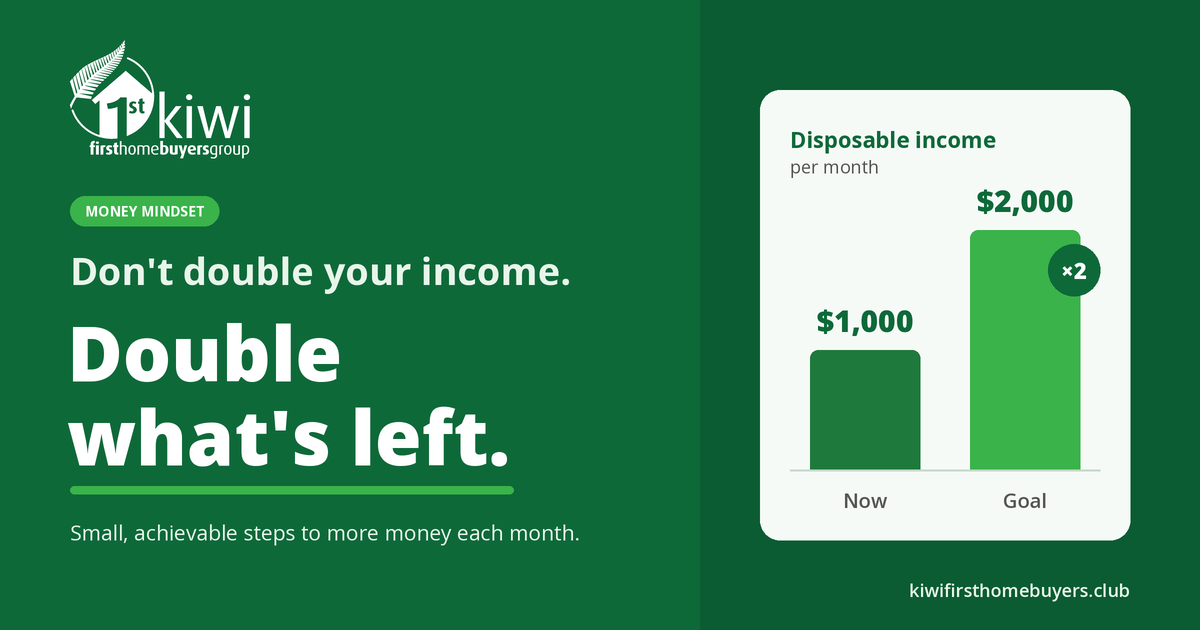
Say you bring home $5,000 a month and essentials cost $4,000. Your starting point is $1,000.
Haven’t run these numbers yet? That’s your first job.
Step 2: Double that number, not your salary
Forget doubling your whole income. What would it take to turn that $1,000 into $2,000? That’s an extra $1,000 a month, a 20% lift on your take-home pay, but twice the money you get to make choices with.
And you may not even need a full double. An extra $500 is still half as much again to play with.
Step 3: Decide what it’s for, then go find it
The extra money has to mean something to you, or you won’t chase it. Invest, save, pay down debt, travel with the kids, or simply enjoy life without dreading the next bill. That’s the gap between survival mode and having choices.
Finding it is the creative bit, and it doesn’t have to come from one place.
Selling things to clear buy-now-pay-later or interest-free debts works too: every repayment you stop frees up dollars. And a reminder from the accountant in me: if you’re earning more, factor in tax.
It’s not what comes in, it’s what you keep
Someone earning an income of $150,000 a year isn’t automatically better off than someone that is on $90,000 a year.
If lifestyle costs swallow everything, the bigger salary buys nothing extra.
Doubling your disposable income won’t be easy. But the number you’re trying to double is probably much smaller than you thought. When a goal feels achievable, you’re far more likely to act on it.
So skip the impossible salary or income targets!
Work on the money you actually have available, see if you can find a little more and then see how differently you feel about your finances.
If you plan to buy a home soon, then budgeting your income and expenses plus knowing where to start really can help.